Series 16i/160i-LB Descriptions Page 87
Descriptions
B-63662EN/01 11.CONTROL FUNCTIONS
- 81 -
11.1 OPTICAL PATH LENGTH COMPENSATION
If there is a movable reflector, the propagation distance between the
oscillator and condensing lens varies as the reflector moves.
Generally, stable machining characteristics are obtained within a
limited propagation distance range. In a large machine tool in which
the reflector has to move through a long distance because of its
mechanical structure, the required propagation distance may exceed
its limit, hampering stable machining over the stroke of reflector
movement. To solve this problem, the 16i-LB is provided with an
optical path adjustment axis and an optical path length compensation
function. When a command is issued which requests that the reflector
be moved, the optical path length compensation function
automatically adjusts the optical path adjustment axis to maintain a
constant optical path length.
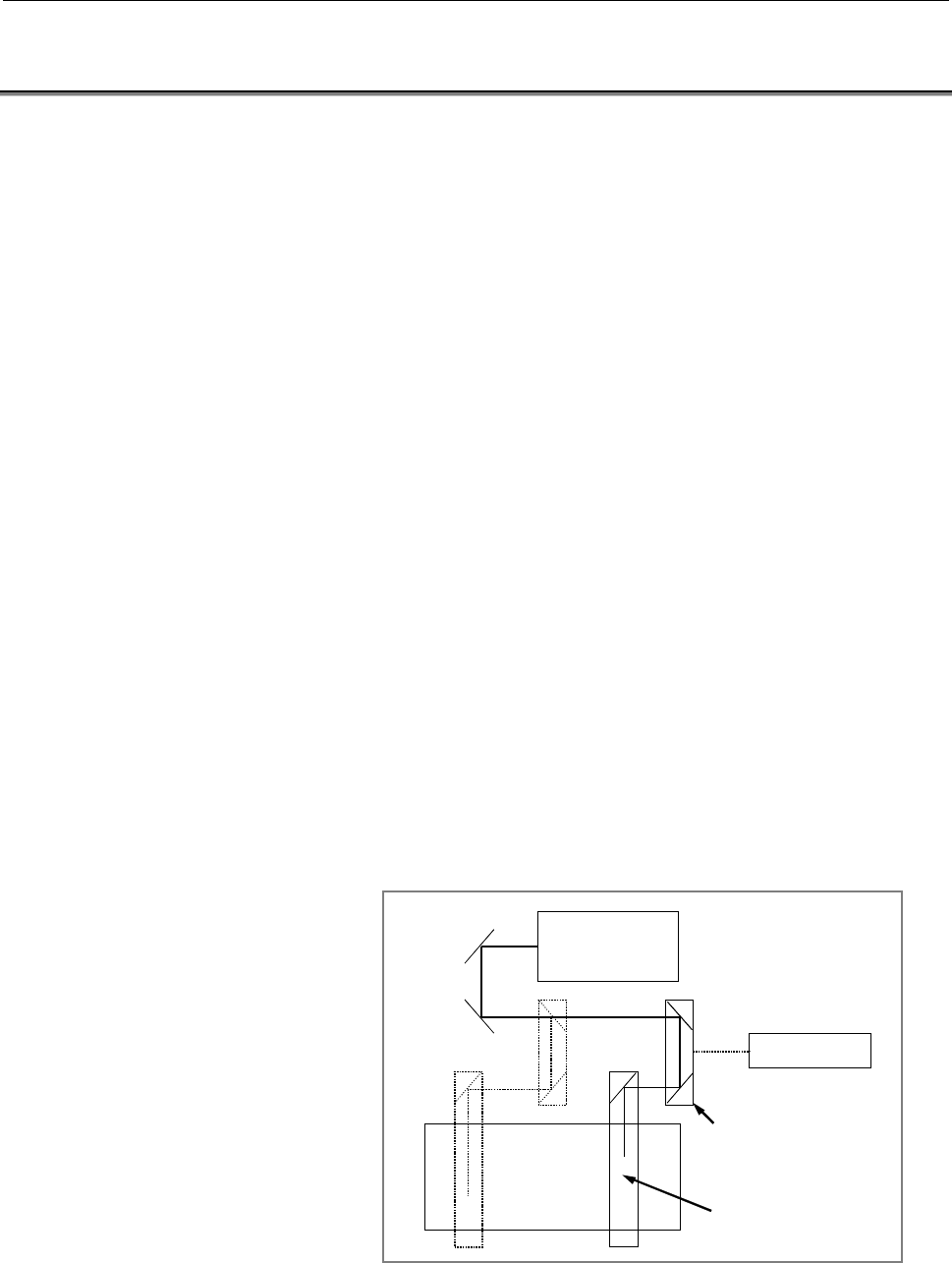
Optical path length compensation uses the following mechanism.
1 An axis (called the U-axis) must be available along which a
beam reflecting mirror block (shown below) moves linearly to
vary the propagation distance.
2 The U-axis should be configured to change the propagation
distance α times (1 to 511) as much as the movement of the
mirror block.
3 The maximum speed of the U-axis should be higher than or
equal to 1/α the total rapid traverse rate of the axes that can
change the optical path length.
4 All axes including the U-axis should have reference point. The
optical path length is calculated based on the reference point.
5 An interference protection provision should be installed for all
axes that may otherwise interfere with the U-axis.
Oscillator
U-axis
Mirror block
Nozzle head
Contents Summary of Series 16i/160i-LB Descriptions
- Page 1DESCRIPTIONS B-63662EN/01
- Page 2Ȧ No part of this manual may be reproduced in any form. Ȧ All specifications and designs are subject to change without notice. The export of this product is subject to the authorization of the government of the country from where the product is exported. In this manual we have tried as much as possi
- Page 3B-63662EN/01 TABLE OF CONTENTS TABLE OF CONTENTS 1 GENERAL................................ GENERAL ................................................................ ................................................................................................ .......................................
- Page 4TABLE OF CONTENTS B-63662EN/01 8.2.2 Displaying the Data................................................................................................................. 40 8.2.3 Updating the Data .......................................................................................................
- Page 5B-63662EN/01 TABLE OF CONTENTSGENERAL 10.1.3 Interaction Control .................................................................................................................. 67 10.1.4 A-axis Length Compensation Function ..........................................................................
- Page 6
- Page 7B-63662EN/01 1.GENERAL 1 GENERAL The FANUC Series 16i/160i-LB is a CNC dedicated for use in a laser machine tool and developed based on the FANUC Series 16i/160i- MODEL B. When combined with a FANUC laser, it can be configured into a laser machine tool. This manual supplements "FANUC Series 16i/18i/
- Page 81.GENERAL B-63662EN/01 Manuals related to Series 16i/160i-LB The table below lists manuals related to the FANUC Series 16i/160i- LB. In the table, this manual is marked with an asterisk (*). Manuals related to the Series 16i/160i-LB Manual name Specification number FANUC Series 16i/18i/160i/180i-MOD
- Page 9B-63662EN/01 2.SPECIFICATIONS 2 SPECIFICATIONS For functions other than the laser functions, refer to "FANUC Series 16i/18i/21i/20i/160i/180i/210i-MODEL B Descriptions" (B-63522EN). Some functions described in manual B-63522EN may not be supported by the 16i-LB/160i-LB or may differ from those of th
- Page 102.SPECIFICATIONS B-63662EN/01 CNCs which can be combined with a oscillator are Series16i-LB and Series160i-LB. : Standard specifications : Standard optional specifications : Not applicable * : Specifications included in other specifications Axis control Item Specifications 16i-LB 160i-LB Maximum tot
- Page 11B-63662EN/01 2.SPECIFICATIONS Item Specifications 16i-LB 160i-LB Separate backlash compensation for rapid traverse and cutting feed Stored pitch error compensation Gradient compensation Straightness deviation compensation Position switch Abnormal load detection Fine torque sensing High-speed positio
- Page 122.SPECIFICATIONS B-63662EN/01 Item Specifications 16i-LB 160i-LB (Circular interpolation) + (Linear Helical interpolation B interpolation for up to 4 axes) Hypothetical axis interpolation Skip G31 Reference position return G28 Reference position return check G27 2nd reference position return 3rd/4th
- Page 13B-63662EN/01 2.SPECIFICATIONS Item Specifications 16i-LB 160i-LB O with 4 digits Program number O with 8 digits Sequence number N with 5 digits Combined programming in a single block Absolute/incremental programming allowed Decimal point input/pocket calculator type decimal point input Input unit (1
- Page 142.SPECIFICATIONS B-63662EN/01 Tool functions/Tool compensation functions Item Specifications 16i-LB 160i-LB Tool function T with 8 digits ± with 6 digits, 32 items ± with 6 digits, 64 items ± with 6 digits, 99 items Tool offset pairs ± with 6 digits, 200 items ± with 6 digits, 400 items ± with 6 dig
- Page 15B-63662EN/01 2.SPECIFICATIONS Item Specifications 16i-LB 160i-LB Reading information for mounted printed Remote diagnosis circuit board, CNC data such as * * parameters, alarm status, etc. Run time and parts number display Actual cutting speed display Floppy cassette directory display Directory disp
- Page 162.SPECIFICATIONS B-63662EN/01 Item Specifications 16i-LB 160i-LB Power mate CNC manager Communication function Item Specifications 16i-LB 160i-LB Embedded Ethernet Ethernet Optional board is necessary. PROFIBUS–DP Master/slave DeviceNet Master/slave FOCAS1/HSSB PORT2 function G32 Laser control funct
- Page 17B-63662EN/01 2.SPECIFICATIONS Item Specifications 16i-LB 160i-LB Three-dimensional conversion function G98, G99 Teaching function Step feed return Bevel cutting compensation function Others Item Specifications 16i-LB 160i-LB NC ready, servo ready, automatic Status output signal operation, reset, ala
- Page 182.SPECIFICATIONS B-63662EN/01 Item Specifications 16i-LB 160i-LB 2–phase pulse interface for separate pulse Position detector interface unit coder/linear optical scale (for full-closed control) Serial interface for separate pulse coder/linear optical scale Linear scale interface with absolute addres
- Page 19B-63662EN/01 3.FUNCTIONS DIFFERENT FROM THOSE OF THE M SERIES CNC 3 FUNCTIONS DIFFERENT FROM THOSE OF THE M SERIES CNC Some functions described in "FANUC Series 16i/18i/21i/20i/160i/180i/210i-MODEL B Descriptions" (B- 63522EN) are supported by the 16i/160i-LB, but may be different in specification f
- Page 203.FUNCTIONS DIFFERENT FROM THOSE OF THE M SERIES CNC B-63662EN/01 3.1 EMERGENCY STOP If an emergency stop occurs when the oscillator is operating, the oscillator shutter is closed, the laser beam is turned off, the high- frequency power supply is turned off to stop discharge, and the assist gas sele
- Page 21B-63662EN/01 3.FUNCTIONS DIFFERENT FROM THOSE OF THE M SERIES CNC 3.5 SINGLE BLOCK When a block in which machining is carried out with the laser beam turned on ends, feeding stops, the laser beam is turned off, the shutter is closed, and the assist gas supply stops. Pressing the cycle start button s
- Page 224.LASER FUNCTIONS B-63662EN/01 4 LASER FUNCTIONS - 16 -
- Page 23B-63662EN/01 4.LASER FUNCTIONS 4.1 LASER INTERFACE Because the 16i-LB can be connected to a laser oscillator via a dedicated interface, it can be used to configure a high-performance laser machine easily. (1) Connection via a serial interface The I/O link interface can be used to connect the 16i-LB
- Page 244.LASER FUNCTIONS B-63662EN/01 4.2 CONNECTABLE OSCILLATORS The following oscillators can be connected to the 16i-LB. 1 CO2 laser oscillator : FANUC LASER C series 2 Continuous-output YAG laser oscillator : FANUC LASER Y series - 18 -
- Page 25B-63662EN/01 5.LASER SEQUENCE CONTROL 5 LASER SEQUENCE CONTROL The 16i-LB supports laser sequence control for automatically starting and stopping the FANUC laser oscillator. Input/output signals provided between the CNC and PMC make it possible to program the start/stop operation of the laser oscill
- Page 265.LASER SEQUENCE CONTROL B-63662EN/01 5.1 SEQUENCE CONTROL OF THE C AND Y SERIES LASER OSCILLATORS The sequence control of the CO2 laser oscillator (C series) and the continuous-output YAG laser oscillator (Y series) is shown below. Oscillator not supplied with power Power on Power off Initial state
- Page 27B-63662EN/01 6.ASSIST GAS CONTROL 6 ASSIST GAS CONTROL - 21 -
- Page 286.ASSIST GAS CONTROL B-63662EN/01 6.1 ASSIST GAS CONTROL Assist gas control is performed using a direct gas pressure control command or a flow pattern command. Direct gas pressure command The type and pressure of an assist gas to be used and the settling time of the assist gas pressure can be contro
- Page 29B-63662EN/01 6.ASSIST GAS CONTROL - Format G32L- ; L=0 : The shutter is closed, and the assist gas supply is stopped. L=1 : The shutter is opened, and the assist gas supply is started according to cutting condition data. L=2 : The shutter is opened, and the assist gas supply is started according to
- Page 306.ASSIST GAS CONTROL B-63662EN/01 NOTE The assist gas and shutter are controlled synchronously. While the assist gas is being output, therefore, the shutter is open. In this condition, do not insert your hand below the nozzle. - 24 -
- Page 31B-63662EN/01 6.ASSIST GAS CONTROL 6.2 ASSIST GAS PRESSURE ANALOG OUTPUT Specifying assist gas control causes the analog voltage signal to be generated according to the specified assist gas pressure. Operating the control valve according to this signal received at the outside enables automatic adjust
- Page 326.ASSIST GAS CONTROL B-63662EN/01 6.3 ASSIST GAS PRESSURE OVERRIDE The assist gas analog output can be overridden with a percentage from 0 to 200% in 1% steps. - 26 -
- Page 33B-63662EN/01 7.SHUTTER OPEN/CLOSE CONTROL 7 SHUTTER OPEN/CLOSE CONTROL The oscillator output section has a safety provision. It is a shutter mechanism that can mechanically shut off the laser beam output as required. To output the laser beam, it is necessary to open the shutter previously. There are
- Page 348.LASER OUTPUT CONTROL B-63662EN/01 8 LASER OUTPUT CONTROL - 28 -
- Page 35B-63662EN/01 8.LASER OUTPUT CONTROL 8.1 C AND Y SERIES LASER CONTROL The 16i-LB supports laser output control functions for the CO2 laser (C series) and continuous-output YAG laser (Y series). When the shutter is open, and the piercing command (G24) or a cutting feed command (G01, G02, G03, or G12)
- Page 368.LASER OUTPUT CONTROL B-63662EN/01 8.1.1 Power Value Command and Power Override The laser power is specified with a value that follows the S address in a laser output command. G01 X_Y_F_Sxxxx ; S : Specifies the power value. Valid data range : 0 to 7000 W(*1) Minimum increment : 1W (*1) The maximum
- Page 37B-63662EN/01 8.LASER OUTPUT CONTROL 8.1.2 Pulse Frequency Command and Frequency Override The frequency of the output pulse is specified by a value that follows the P address in the laser output command. G01 X_Y_F_S_Pxxxx ; P : Specifies the pulse frequency. Valid data range : 5 to 2000 Minimum incre
- Page 388.LASER OUTPUT CONTROL B-63662EN/01 8.1.3 Pulse Duty Cycle Command and Duty Cycle Override The duty cycle of the output pulse is specified by a value that follows the Q address in the laser output command. G01 X_Y_F_S_P_Qxxx ; Q : Specifies the pulse duty cycle. Valid data range : 0 to 100 Minimum i
- Page 39B-63662EN/01 8.LASER OUTPUT CONTROL 8.1.4 Piercing Commands The piercing function outputs the beam for a specified time, without moving the machine. This function is used to pierce a workpiece with the beam before starting to cut the workpiece. The piercing commands support high-speed piercing, whic
- Page 408.LASER OUTPUT CONTROL B-63662EN/01 (2) Indirect command If the optional cutting condition setting function is added, specify the piercing data number using address E to execute high-speed piercing. In this case, set a positive number in the "number of steps" item corresponding to the specified pier
- Page 41B-63662EN/01 8.LASER OUTPUT CONTROL 8.1.5 External Alteration of the Piercing Time The piercing time specified in G24 can be changed using an external signal. (1) Extending the piercing time If the "extension" signal is turned on during piercing, piercing continues as long as the signal remains on.
- Page 428.LASER OUTPUT CONTROL B-63662EN/01 8.1.6 Power Control The power control function controls the laser output by changing the actual feedrate. This function is valid when G63P1 is specified (where the power control for the laser settings is set to 1) and invalid when G63P0 is specified. To enable or
- Page 43B-63662EN/01 8.LASER OUTPUT CONTROL 8.1.8 Laser Machining Program Example S a1 E a5 b1 a2 a3 a4 b2 b3 G00X_ Y_ ; : Positioning at a1 from S G00Z_ ; : Positioning at a2 G13Pxxxx ; : Start tracing control. Approach a3. When approach is completed, the next block is executed. G32Px Txxx Rxxx ; : Open th
- Page 448.LASER OUTPUT CONTROL B-63662EN/01 8.2 CUTTING CONDITION SETTING FUNCTION This function saves laser machining data (otherwise specified using the S, P, and Q addresses separately) all together in memory and enables machining according to the saved data read out by specifying the corresponding data
- Page 45B-63662EN/01 8.LASER OUTPUT CONTROL (2) Cutting data group The cutting data group consists of ten sets of the data listed below. Its data numbers are 1 to 10 and specified with the E code. [Item] [Valid data range] [Minimum increment] Feedrate :0 to 99999 :mm/min Peak value for contouring :0 to 9999
- Page 468.LASER OUTPUT CONTROL B-63662EN/01 (5) Parameter switching data group The parameter switching data group consists of six sets of the following items. A data number is specified using an E code from 501 to 506. For details of the settings, refer to the "AC Servo Parameter Manual." [Parameter No.] X-
- Page 47B-63662EN/01 8.LASER OUTPUT CONTROL 8.2.3 Updating the Data (1) Correction function based on data screen operation Select and display a target screen, and press the [OPRT] soft key. Correction will be enabled. Place the cursor on the target item, and take the necessary action. When data at the curre
- Page 488.LASER OUTPUT CONTROL B-63662EN/01 8.2.4 Executing the Data (1) Piercing command When G24 is executed, a data group specified with the E code is read from the data area to carry out piercing. The E code can be specified independently. G24 Exxx ; Exxx : Piercing data number (101 to 103) (2) Reading
- Page 49B-63662EN/01 8.LASER OUTPUT CONTROL 8.2.5 Program Example The following example is a program using a cutting condition setting function. G92 X_Y_Z_ ; : Select a coordinate system. E01 ; : Specify a cutting data set number in the data area. E101 ; : Specify a piercing data set number in the data area
- Page 508.LASER OUTPUT CONTROL B-63662EN/01 8.2.6 Sending the Data The data area is limited in capacity. To store more data, it is necessary to expand the data area using a macro variable or battery-powered memory for PMC C language, and send the necessary data from the expansion area to the data area as re
- Page 51B-63662EN/01 8.LASER OUTPUT CONTROL 8.3 EDGE MACHINING FUNCTION The edge machining function detects edges, controls deceleration-to- stop, performs piercing, and controls the feedrate and power during a shift from piercing to cutting.It is intended to produce sharp edges. Using this function require
- Page 528.LASER OUTPUT CONTROL B-63662EN/01 8.3.2 Feedrate and Power Control Machining at a shift from block A to block B is carried out as shown below. Feedrate /power Fa Fb Se, Pe, Qe Sa, Pa, Qa Fr Sb, Pb, Qb Sb, Pr, Qr Time Block A Te Lr Block B Fa : Feedrate in block A Sa : Output peak value in block A
- Page 53B-63662EN/01 8.LASER OUTPUT CONTROL 8.3.3 Data Setting See the description of the cutting condition setting function for the edge machining data item. 8.3.4 Command The edge machining function is enabled by specifying an edge data number at "edge selection" in the machining data specified with the E
- Page 548.LASER OUTPUT CONTROL B-63662EN/01 8.4 START-UP FUNCTION When a shift occurs from piercing to cutting, cutting may not be stable if it is started with the cutting data. The start-up function controls the feedrate and power at a shift from piercing to cutting in the same manner as with the end of ed
- Page 55B-63662EN/01 8.LASER OUTPUT CONTROL 8.4.2 Setting the Data The following edge machining data specified using the cutting condition setting function becomes effective. [Item] [Valid data range] [Minimum increment] Return distance :0 to 99.999 :mm Return speed :0 to 9999 :mm/min Return frequency :5 to
- Page 568.LASER OUTPUT CONTROL B-63662EN/01 8.5 GUIDE LIGHT ON SIGNAL If the laser oscillator is equipped with the guide light option (semiconductor laser or He-Ne laser unit), the laser beam from the guide light laser unit can be switched on and off using an external signal. If the oscillator shutter is cl
- Page 57B-63662EN/01 8.LASER OUTPUT CONTROL 8.6 STATUS OUTPUT SIGNAL 8.6.1 Piercing Signal For the C and Y series oscillators, if G24 is executed to specify piercing, the piercing signal is output when piercing is being carried out. 8.6.2 Laser Processing Signal For the C and Y series oscillators, the laser
- Page 588.LASER OUTPUT CONTROL B-63662EN/01 8.6.4 Laser Alarm Signal A laser alarm is raised if an error related to the laser oscillator is detected. (1) C and Y series oscillators • Low water level • Chiller unit failure • Abnormal laser gas pressure • Abnormal exhaust time • Root blower failure • Abnormal
- Page 59B-63662EN/01 8.LASER OUTPUT CONTROL 8.6.5 Status Output Signals (1) Purge completion signal This signal is issued, when the unit is switched on, and the CNC starts operating. When this signal is issued, the RUN signal becomes acceptable. When the RUN signal is turned off, purge processing occurs to
- Page 608.LASER OUTPUT CONTROL B-63662EN/01 8.7 Step Function The step function controls the laser power in steps for a set distance, starting from the weld start point and for another set distance ending at the weld end point when welding is performed with laser beam machining, to achieve good welding resu
- Page 61B-63662EN/01 8.LASER OUTPUT CONTROL • Valid data ranges The valid data ranges are as follows: Ramp UP/DOWN step distance : 0 to 65.000 mm Step power : 0 to 7000 W Ramp UP/DOWN operation is performed by measuring the distance of the straight line from the machining start point to the machining end po
- Page 628.LASER OUTPUT CONTROL B-63662EN/01 • This function is not effective when the single block, dry run, or machine lock function is used. • This function is valid only for X-Y facing. It cannot be used with functions for cylindrical machining, normal direction control, three-dimensional machining, etc.
- Page 63B-63662EN/01 9.TRACING CONTROL 9 TRACING CONTROL - 57 -
- Page 649.TRACING CONTROL B-63662EN/01 9.1 TRACING FUNCTION The machine is equipped with a detector to measure the distance to the surface of the workpiece. An analog signal generated in this detector is sent to the CNC through a specified interface. This signal enables gap control in which the Z-axis is co
- Page 65B-63662EN/01 9.TRACING CONTROL 9.1.3 Tracing Speed On receiving an analog signal from the detector, the CNC subtracts the reference deviation E0 from it and multiplies the difference by loop gain K to calculate the speed command for the Z-axis. The loop gain can be specified using a parameter. Vz =
- Page 669.TRACING CONTROL B-63662EN/01 9.1.6 Tracing Adjustment Function The tracing adjustment function enables zero-point and detection gain factor adjustments necessary to normalize the input signal to the specified deviation. This is done using soft keys displayed on the CRT screen. 9.1.7 Tracing Alarms
- Page 67B-63662EN/01 9.TRACING CONTROL 9.2 TRACING INTERLOCK FUNCTION If the machine receives a tracing interlock signal from the PMC during tracing operation specified by G13; , it suspends the operation of the tracing axis as long as the signal is on. When the tracing interlock signal is turned off, the m
- Page 6810.FUNCTION FOR THREE-DIMENSIONAL PROCESSING SYSTEM B-63662EN/01 10 FUNCTION FOR THREE-DIMENSIONAL PROCESSING SYSTEM - 62 -
- Page 69B-63662EN/01 10.FUNCTION FOR THREE-DIMENSIONAL PROCESSING SYSTEM 10.1 ATTITUDE CONTROL When at least five controlled axes are specified and attitude control is also specified, control can be applied to the attitude of the nozzle with the fourth and fifth axes used as rotational axes. Using this func
- Page 7010.FUNCTION FOR THREE-DIMENSIONAL PROCESSING SYSTEM B-63662EN/01 10.1.1 Attitude Control A (Zero Offset Type Head) The zero offset type mechanism is configured with the α axis (fourth axis) to rotate the nozzle about the Z-axis, and the β axis (fifth axis) which is a rotational axis placed at an ang
- Page 71B-63662EN/01 10.FUNCTION FOR THREE-DIMENSIONAL PROCESSING SYSTEM 10.1.2 Attitude Control B (Offset Type Head) The offset type mechanism is configured with the α axis (fourth axis) to rotate around Z axis, and the rotational axis β axis (fifth axis) recorded in this α axis. It possesses the structure
- Page 7210.FUNCTION FOR THREE-DIMENSIONAL PROCESSING SYSTEM B-63662EN/01 (1) Mode selection In automatic operation, the nozzle tip fixed mode automatically occurs. In manual operation, an external signal can be used to switch between nozzle tip fixed mode and independent axis mode. (2) Independent axis mode
- Page 73B-63662EN/01 10.FUNCTION FOR THREE-DIMENSIONAL PROCESSING SYSTEM 10.1.3 Interaction Control In nozzle attitude control, as shown in the diagram of the axis configuration of the nozzle head, the β axis motor is arranged around the Z axis. In the case of a structure which transmits by gear, if the α a
- Page 7410.FUNCTION FOR THREE-DIMENSIONAL PROCESSING SYSTEM B-63662EN/01 10.2 TEACHING BOX INTERFACE The CNC can be connected to a teaching box interface in the machine through a serial interface. The CNC can send teaching data requested by the teaching box. It can also receive commands generated by teachin
- Page 75B-63662EN/01 10.FUNCTION FOR THREE-DIMENSIONAL PROCESSING SYSTEM J : Reads the specified block K : Writes the specified block (insertion) L : Deletes the specified block M : Sequence number search N : Command of the MDI operation O : Nozzle tip machine position data P : Request three-dimensional con
- Page 7610.FUNCTION FOR THREE-DIMENSIONAL PROCESSING SYSTEM B-63662EN/01 10.3 THREE-DIMENSIONAL CONTROL FUNCTION 10.3.1 W Axis Tracing Control The W axis is arranged such that linear operation of the nozzle tip section can be performed, and the gap sensor is connected at the prescribed interface. If this fu
- Page 77B-63662EN/01 10.FUNCTION FOR THREE-DIMENSIONAL PROCESSING SYSTEM 10.3.2 Spatial Circular Interpolation Command method G12 Xx1 Yy1 Zz1 Aa1 Bb1 Ss Pp Qq ; G12 Xx2 Yy2 Zz2 Aa2 Bb2 ; The first block represents the intermediate point on an arc, and the second block represents the end point of the arc. If
- Page 7810.FUNCTION FOR THREE-DIMENSIONAL PROCESSING SYSTEM B-63662EN/01 10.3.3 Three-dimensional Coordinate Conversion Command method G68 Xx Yy Zz Aa Bb Ii Jj Kk ; Program to be converted G69 ; The program put in between the commands G68 and G69 is coordinate- converted. (1) The program to be converted is
- Page 79B-63662EN/01 10.FUNCTION FOR THREE-DIMENSIONAL PROCESSING SYSTEM 10.3.4 Spatial Corner-R Insertion Command method G33 Rr ; Target program G34 ; (1) The arc having the specified radius is automatically inserted to each corner obtained by the spatial dot-strings put in between commands G33 and G34. (2
- Page 8010.FUNCTION FOR THREE-DIMENSIONAL PROCESSING SYSTEM B-63662EN/01 10.3.5 Three-dimensional Conversion Function A machining program is subjected to three-dimensional conversion by specifying a target point in reference to an arbitrary point in the coordinate system of the machining program. This funct
- Page 81B-63662EN/01 10.FUNCTION FOR THREE-DIMENSIONAL PROCESSING SYSTEM (a) Mirror image conversion G98 P0 X_Y_Z_ ; Reference point G98 Q0 X_Y_Z_ ; Target point (b) Three-dimensional movement conversion G98 P1 X_Y_Z_ ; Reference point G98 P2 X_Y_Z_ ; Reference point G98 P3 X_Y_Z_ ; Reference point G98 Q1 X
- Page 8210.FUNCTION FOR THREE-DIMENSIONAL PROCESSING SYSTEM B-63662EN/01 10.3.6 Proximity Point Search In the memory operation mode, if the proximity point search (DI) is turned on and the cycle start is carried out, the block in the nearest position to the current position of the nozzle is searched as desc
- Page 83B-63662EN/01 10.FUNCTION FOR THREE-DIMENSIONAL PROCESSING SYSTEM 10.3.7 Manual Operation Using a Hand Coordinate System In attitude control A and B, the coordinate system defined using the attitude of the nozzle when the nozzle tip position is used as the origin is called the hand coordinate system.
- Page 8410.FUNCTION FOR THREE-DIMENSIONAL PROCESSING SYSTEM B-63662EN/01 (2) Definition of the hand coordinate system in attitude control A (offset type head) - Direction normal to the nozzle: +Zh - α axis arm direction: +Xh - Left forefinger finger direction orthogonal to the left middle direction (+Xh) an
- Page 85B-63662EN/01 10.FUNCTION FOR THREE-DIMENSIONAL PROCESSING SYSTEM 10.3.8 Bevel Cutting Compensation Function In most cases, in bevel cutting, the tool center point TCP during tip- fixed processing (attitude control B) is at the bottom of the workpiece. When the bevel angle is changed during tip-fixed
- Page 8611.CONTROL FUNCTIONS B-63662EN/01 11 CONTROL FUNCTIONS - 80 -
- Page 87B-63662EN/01 11.CONTROL FUNCTIONS 11.1 OPTICAL PATH LENGTH COMPENSATION If there is a movable reflector, the propagation distance between the oscillator and condensing lens varies as the reflector moves. Generally, stable machining characteristics are obtained within a limited propagation distance r
- Page 8811.CONTROL FUNCTIONS B-63662EN/01 (1) Detectors on the controlled axes can be incremental and/or absolute pulse coders (APC). The two types can be intermixed. (2) Any axis from the fourth axis to the eight axis can be assigned as the U-axis. (3) A U-axis move command is generated based on the moveme
- Page 89B-63662EN/01 11.CONTROL FUNCTIONS 11.2 MACHINING RESTART FUNCTION Burning may occur during laser machining, preventing machining from continuing. In such a case, machining may be resumed by putting the machine back in the state in which it was before burning. This is done by a machining restart func
- Page 9011.CONTROL FUNCTIONS B-63662EN/01 <3> When retracting is completed, the machine retraces the specified distance, then stops. After confirming the retrace completed signal and turning off the retrace signal, triggering automatic operation causes the nozzle to approach the surface of the workpiece. <4
- Page 91APPENDI
- Page 92
- Page 93B-63662EN/01 APPENDIX A.LASER SETTING SCREEN A LASER SETTING SCREEN (1) Laser power display The laser output display screen displays the following data. LASER POWER O0000 N00000 PC 1000 W PA 1000 W FR 2000 Hz DU 100 % E 0.000 MM >_ S 0 T0000 MDI **** *** *** 21:20:07 [ POWER ][ SET ][ ][ ][ ] - 87 -
- Page 94A.LASER SETTING SCREEN APPENDIX B-63662EN/01 (2) Laser setting The laser setting screen consists of three pages shown below. LASER SETTING O0000 N00000 CONTOURING POWER = 1000 W FREQUENCY= 2000 Hz DUTY = 100 % PIERCING POW4R = 800 W FREQUENCY= 1000 Hz DUTY = 50 % POWER SELECT = 0 (0:ALL,1:HLF) POWER
- Page 95B-63662EN/01 APPENDIX A.LASER SETTING SCREEN (3) Trace setting This screen displays the following tracing data. TRACE SETTING O0000 N00000 Z-DEFLECTIONPOSITION = 1.000 (RELATIVE) ZERO ADJUST X 7.213 E 0.143 Y 9.596 GAIN COEFFICIENT Z -14.559 START POINT Z -14.059 E 0.048 END POINT Z -14.559 DEFLECTI
- Page 96B.CUTTING CONDITION SETTING SCREENS (WHEN DISPLAYED ON A 10.4" LCD or EQUIVALENT) APPENDIX B-63662EN/01 B CUTTING CONDITION SETTING SCREENS (WHEN DISPLAYED ON A 10.4" LCD or EQUIVALENT) (1) Cutting data screen This screen displays the following cutting data. [CUTTING] ACTIVE DATA NO. [CUTTING=5 PIRC
- Page 97B-63662EN/01 APPENDIX B.CUTTING CONDITION SETTING SCREENS (WHEN DISPLAYED ON A 10.4" LCD or EQUIVALENT) (3) Edge machining data screen This screen displays the following edge machining data. [EDGE] ACTIVE DATA NO.[CUTTING=5 PIRCING=103] PIRC GAS GAS STRTSTRT STRT STRT No. ANGL PWR. FREQ. DUTY TIME P
- Page 98
- Page 99B-63662EN/01 INDEX INDEX FUNCTIONS DIFFERENT FROM THOSE OF A THE M SERIES CNC ................................... 13 A-axis Length Compensation Function........... 67 G ASSIST GAS CONTROL............................ 21, 22 ASSIST GAS PRESSURE OVERRIDE........... 26 GLE BLOCK ........................
- Page 100INDEX B-63662EN/01 Power Control ................................................... 36 STATUS OUTPUT SIGNAL ............................ 51 Power Value Command and Power Override . 30 Status Output Signals ...................................... 53 Program Example ...................................
- Page 101Revision Record FANUC Series 16i/160i-LB DESCRIPTIONS (B-63662EN) 01 Mar., 2002 Edition Date Contents Edition Date Contents
- Page 102