Laser C1000/C2000/C4000/C5000/C6000-Model E Operators manual Page 19
Operators manual
B-70264EN/02 1.NOTES ON USE
- 5 -
1.3 LASER GAS
1.3.1 Laser gas specification
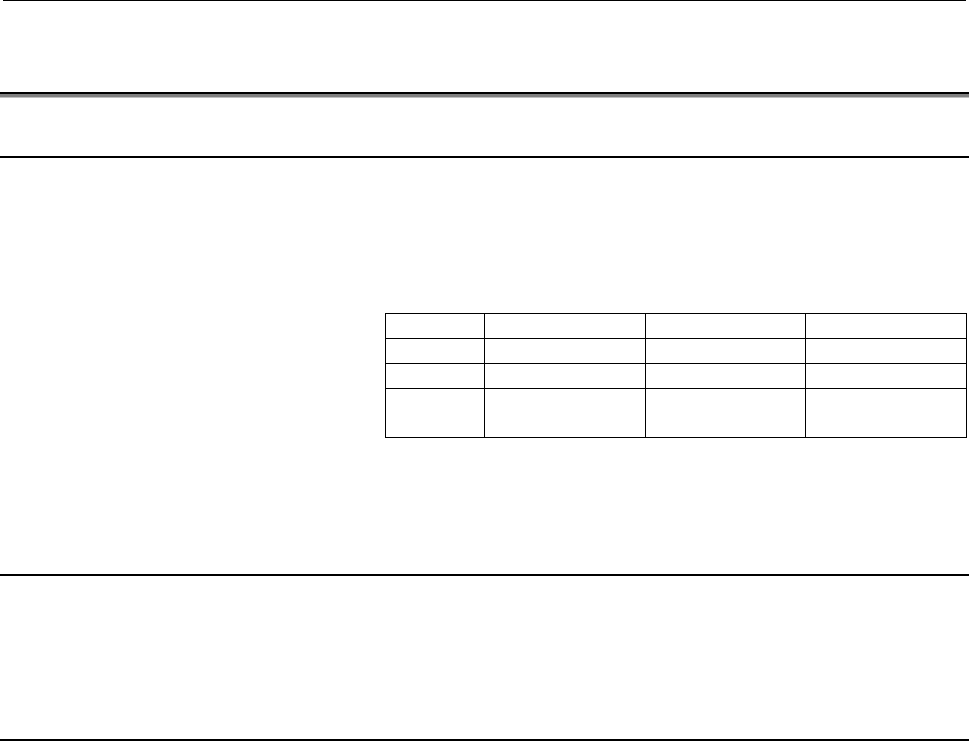
Supply the laser oscillator with a mixture of gases that satisfy the
conditions listed below.
(1) Composition ratio and accuracy
(For the composition ratio, check the label and specifications of
the oscillator.)
Gas A Gas B Gas C
CO
2
5±0.25% 5±0.25% 5±0.25%
He 40±2% 60±3% 70±3.5%
N
2
55±2.75%
(N
2
balance)
35±1.75%
(N
2
balance)
25±1.25%
(N
2
balance)
(2) Water (H
2
O): 5 ppm or less
(3) Hydrocarbon (C
n
H
m
): 1 ppm or less
(4) Gas purity: 99.99% or higher
1.3.2 Supply Gas Pressure
Set the pressure so that the secondary pressure as measured at the
regulator on the laser gas cylinder falls into the range of
0.175MPa±0.025MPa.
1.3.3 Replacing the Laser Gas Cylinder
If the primary pressure of the regulator installed in the laser gas
cylinder is 1 MPa or less, replace the laser gas cylinder with new one.
When laser gas runs out during oscillator operation, the oscillator
stops automatically. In this case, after the oscillator stops, replace the
gas cylinder.
When replacing the gas cylinder, close the main plug of the gas
cylinder, completely loosen the adjustment valve of the regulator,
then remove the regulator. If the adjustment valve of the regulator is
left tightened, external air will enter the piping. When the oscillator is
started after the replacement of the cylinder, the external piping
exhaust operates to remove gas inside the piping, and the oscillator
starts in the normal sequence.
When laser gas runs out during purging, a stop occurs while the inside
of the piping is in the negative pressure state. If the gas cylinder is
replaced in this state, the atmosphere is sucked. Therefore, be sure to
loosen the adjustment valve of the regulator before removing the
regulator.
Before the oscillator starts, the external piping exhaust operation
takes place then the automatic aging function operates to perform
aging in the oscillator to prevent possible troubles from occurring if
the atmosphere should be sucked.
Contents Summary of Laser C1000/C2000/C4000/C5000/C6000-Model E Operators manual
- Page 1OPERATOR’S MANUAL B-70264EN/02
- Page 2Ȧ No part of this manual may be reproduced in any form. Ȧ All specifications and designs are subject to change without notice. In this manual we have tried as much as possible to describe all the various matters. However, we cannot describe all the matters which must not be done, or which cannot be
- Page 3B-70264EN/02 SAFETY PRECAUTIONS SAFETY PRECAUTIONS This manual contains precautions which must be observed during operation and maintenance of the laser oscillator to ensure the safety of the operator and maintenance personnel and prevent damage to the oscillator. Maintenance involves a variety of r
- Page 4SAFETY PRECAUTIONS B-70264EN/02 1.1 DEFINITION OF WARNING, CAUTION, AND NOTE To ensure the safety of maintenance personnel (referred to as users) and prevent damage to the machine, this manual indicates each precaution on safety with "Warning" or "Caution" according to its severity. Supplementary in
- Page 5B-70264EN/02 SAFETY PRECAUTIONS 1.2 WARNINGS AND CAUTIONS ON EXPOSURE WARNING 1 It is extremely dangerous to expose your eyes to direct, scattered, or reflected CO2 laser light. Always wear protective glasses while the laser is operating. Exposure to laser light can cause blindness. If your eyes are
- Page 6SAFETY PRECAUTIONS B-70264EN/02 WARNING 6 If there is a possibility of being exposed to CO2 laser radiation exceeding the maximum permissible exposure (MPE) level for skin, wear protective clothing. Otherwise, there is a danger of being burnt. 7 The oscillator is fitted with a red semiconductor lase
- Page 7B-70264EN/02 SAFETY PRECAUTIONS 1.3 WARNINGS AND CAUTIONS ON MAINTENANCE WARNING 1 A high voltage of 3 to 4 kV0-p is applied to some places in the laser oscillator cabinet. Therefore, do not turn the power to the oscillator on or operate the oscillator when an oscillator panel is open. Operating the
- Page 8SAFETY PRECAUTIONS B-70264EN/02 1.4 WARNINGS AND CAUTIONS ON HANDLING WARNING 1 The oscillator output mirror and focusing lens on the machining head both have a substrate made of ZnSe (zinc selenide), a toxic substance. Therefore, do not touch the mirror or lens with your bare hands if it is damaged
- Page 9B-70264EN/02 SAFETY PRECAUTIONS CAUTION 1 The oscillator is controlled according to the CNC internal parameter settings. If a numeric value different from a setting is entered and the oscillator is operated, the oscillator may malfunction. In the worst case, the oscillator may be damaged. 2 Use lase
- Page 10SAFETY PRECAUTIONS B-70264EN/02 1.5 WARNINGS AND CAUTIONS ON MACHINING WARNING 1 Do not look at the machining point without eye protection. Otherwise, your eyes may be exposed to reflected laser light, resulting in blindness. If your eyes are accidentally exposed to laser light, seek medical advice
- Page 11B-70264EN/02 PREFACE PREFACE Contents of the manual This manual consists of the following chapters and appendixes: Chapter 1 : Notes on Use Chapter 1 covers the operating environment conditions, cooling water, laser gas, oscillator mirrors, and notification in accordance with the Radio Law. Chapter
- Page 12
- Page 13B-70264EN/02 TABLE OF CONTENTS TABLE OF CONTENTS SAFETY PRECAUTIONS...........................................................................s-1 PREFACE ..................................................................................................p-1 1 NOTES ON USE .............................
- Page 14TABLE OF CONTENTS B-70264EN/02 5.2 LIST OF ALARMS ....................................................................................... 48 5.3 ALARM DETAILS ........................................................................................ 49 5.4 DISPLAY ITEMS ON THE DIAGNOSIS SCREEN .......
- Page 15B-70264EN/02 1.NOTES ON USE 1 NOTES ON USE To attain stable performance, bear in mind the notes contained in this chapter during use. -1-
- Page 161.NOTES ON USE B-70264EN/02 1.1 OPERATING ENVIRONMENT CONDITIONS (1) Ambient temperature : +5 to 30°C (2) Temperature variation :1.1°C/minute maximum (3) Humidity : 75% or below (relative humidity) (4) Vibration : Acceleration not to exceed 0.05G. Vibration amplitude not to exceed 5µm. (5) Atmospher
- Page 17B-70264EN/02 1.NOTES ON USE 1.2 COOLING WATER Use either pure water or tap water treated in an ion exchanger. Set the water temperature in the range from 20°C to 30°C. Wait for the water temperature to reach 20°C or greater before starting the oscillator. (1) pure water supply unit Install a pure wa
- Page 181.NOTES ON USE B-70264EN/02 (3) Cleaning agent Foreign matters such as fur will adhere to the inside of the cooling water circulating path. Wash the cooling water circulating path using a detergent after every 3,000 hours. Consult the chiller manufacturer for use of the detergent. Product name Manuf
- Page 19B-70264EN/02 1.NOTES ON USE 1.3 LASER GAS 1.3.1 Laser gas specification Supply the laser oscillator with a mixture of gases that satisfy the conditions listed below. (1) Composition ratio and accuracy (For the composition ratio, check the label and specifications of the oscillator.) Gas A Gas B Gas
- Page 201.NOTES ON USE B-70264EN/02 1.4 OSCILLATOR MIRRORS (1) If replacing a mirror, replace it with that purchased from FANUC. If you replace it with a mirror purchased from a source other than FANUC, we cannot guarantee performance or quality. (2) The output mirror falls under the category of special ind
- Page 21B-70264EN/02 1.NOTES ON USE 1.5 POWER CABLE (1) If placing the cable in the duct If laying the power cable by placing it in the duct between the power board and the laser oscillator, use a single-core cable. For the C4000-E, run the 3-phase cable through the conduit (cable clamp) and the ground wire
- Page 221.NOTES ON USE B-70264EN/02 (3) Recommended cable suppliers HitachiCable : Hitachi Cable, Ltd. Furukawa : The Furukawa electric Co., Ltd. LAPP : U.I. Lapp GmbH -8-
- Page 23B-70264EN/02 1.NOTES ON USE 1.6 NOTIFICATION IN ACCORDANCE WITH THE RADIO LAW (APPLICATION FOR PERMISSION OF HIGH-FREQUENCY EQUIPMENT) The energization power supply of the laser oscillator falls under the category of high-frequency equipment in accordance with the Radio Law, and requires an applicat
- Page 242.HANDLING THE LASER BEAM B-70264EN/02 2 HANDLING THE LASER BEAM - 10 -
- Page 25B-70264EN/02 2.HANDLING THE LASER BEAM 2.1 WARNING LABELS The oscillator uses high voltages and laser beam radiation. Such hazards are indicated with warning labels attached to the positions shown in Fig. 2.1 (a) to (j). This section describes the warning labels and their positions. Fig.2.1(a) Warni
- Page 262.HANDLING THE LASER BEAM B-70264EN/02 Fig.2.1(c) Warning label positions (C2000-E : front view) Fig.2.1(d) Warning label positions (C2000-E : rear view) - 12 -
- Page 27B-70264EN/02 2.HANDLING THE LASER BEAM Fig.2.1(e) Warning label positions (C4000-E : front view) Fig.2.1(f) Warning label positions (C4000-E : rear view) - 13 -
- Page 282.HANDLING THE LASER BEAM B-70264EN/02 Fig.2.1(g) Warning label positions (C5000-E : front view) Fig.2.1(h) Warning label positions (C5000-E : rear view) - 14 -
- Page 29B-70264EN/02 2.HANDLING THE LASER BEAM Fig.2.1(i) Warning label positions (C6000-E : front view) Fig.2.1(j) Warning label positions (C6000-E : rear view) - 15 -
- Page 302.HANDLING THE LASER BEAM B-70264EN/02 <1> Class indication label (JPN) Model Maximum output Medium C1000-E 2000W CO2/N2/He = 5/55/40% C2000-E 5000W CO2/N2/He = 5/55/40% C4000-E 8000W CO2/N2/He = 5/55/40% C5000-E 10000W CO2/N2/He = 5/35/60% C6000-E 12000W CO2/N2/He = 5/55/40% <1> Class indication la
- Page 31B-70264EN/02 2.HANDLING THE LASER BEAM <2> Warning label <3> Aperture label <4> Suspension method label <5> Access panel <6> Label inside the access panel - 17 -
- Page 322.HANDLING THE LASER BEAM B-70264EN/02 <7> Discharge section label <8> Certification label <9> Equipment nameplate <10> Manufacturer's address label <11> Label for regulating the atmospheric gases in the oscillator housing - 18 -
- Page 33B-70264EN/02 2.HANDLING THE LASER BEAM <12> Cooling water and gas maintenance label - 19 -
- Page 342.HANDLING THE LASER BEAM B-70264EN/02 2.2 OPTICAL PATHS IN THE OSCILLATOR The figures below show the laser optical paths inside the oscillator. Fig.2.2(a) Optical paths in the C1000-E - 20 -
- Page 35B-70264EN/02 2.HANDLING THE LASER BEAM Fig.2.2(b) Optical paths in the C2000-E Fig.2.2(c) Optical paths in the C4000-E - 21 -
- Page 362.HANDLING THE LASER BEAM B-70264EN/02 Fig.2.2(d) Optical paths in the C5000-E Fig.2.2(e) Optical paths in the C6000-E - 22 -
- Page 37B-70264EN/02 3.INTERNAL STRUCTURE 3 INTERNAL STRUCTURE - 23 -
- Page 383.INTERNAL STRUCTURE B-70264EN/02 3.1 OUTLINE Fig. 3.1 shows an outline of the structure of the oscillator. Fig.3.1 Outline of structure (1) Laser resonator The resonator consists of an output mirror, a rear mirror, folding mirrors, discharge tubes, a power sensor unit, etc. Several discharge tubes
- Page 39B-70264EN/02 3.INTERNAL STRUCTURE (3) Laser gas circulating system A gas circulating system is configured by connecting the resonator and the fan (turbo blower) with a circulating pipe. Laser gas runs through the discharge tubes at a speed of 200 m/s or higher. In this circulating system, a water-co
- Page 403.INTERNAL STRUCTURE B-70264EN/02 3.2 INTERNAL STRUCTURE This section describes the internal structure of the oscillator more specifically. Fig.3.2(a) to (j) are internal structural drawing. Fig.3.2(a) Internal structural drawing (C1000-E : front view) Fig.3.2(b) Internal structural drawing (C1000-E
- Page 41B-70264EN/02 3.INTERNAL STRUCTURE Fig.3.2(c) Internal structural drawing (C2000-E : front view) Fig.3.2(d) Internal structural drawing (C2000-E : rear view) - 27 -
- Page 423.INTERNAL STRUCTURE B-70264EN/02 Fig.3.2(e) Internal structural drawing (C4000-E : front view) Fig.3.2(f) Internal structural drawing (C4000-E : rear view) - 28 -
- Page 43B-70264EN/02 3.INTERNAL STRUCTURE Fig.3.2(g) Internal structural drawing (C5000-E : front view) Fig.3.2(h) Internal structural drawing (C5000-E : rear view) - 29 -
- Page 443.INTERNAL STRUCTURE B-70264EN/02 Fig.3.2(i) Internal structural drawing (C6000-E : front view) Fig.3.2(j) Internal structural drawing (C6000-E : rear view) (1) Output mirror A transmitting/reflecting mirror which outputs the laser beam after it has been amplified inside the resonator. The output mi
- Page 45B-70264EN/02 3.INTERNAL STRUCTURE (3) Folding mirror A mirror with an Si (silicon) substrate coated with dielectric to reflect the laser beam. It linearly polarizes the laser beam. A system equipped with an optional antireflective mirror (ATFR) is available. The antireflective mirror consists of a c
- Page 463.INTERNAL STRUCTURE B-70264EN/02 (12) Turbo PCB This PCB relays overheating and frequency reached signals of the turbo blower. In addition, it monitors the oil level of the turbo blower. (13) Gas dust collection unit This unit is a cyclone dust collector that removes dust that gets in the gas circu
- Page 47B-70264EN/02 3.INTERNAL STRUCTURE (21) Shutter The shutter is normally closed to keep the laser beam inside, and can be opened and closed with CNC commands. It is equipped with a position sensor and a temperature sensor and constantly monitors the open/close status and the shutter mirror temperature
- Page 483.INTERNAL STRUCTURE B-70264EN/02 (30) Guide laser (red semiconductor laser) A diode laser is overlaid on the same optical axis as a guide beam for checking the optical axis because the CO2 laser beam is invisible to the unaided eye. The guide beam is emitted in synchronization with the mechanical s
- Page 49B-70264EN/02 4.MAINTENANCE 4 MAINTENANCE In laser oscillator, periodic inspection items have been reduced, and adjustments have been made easy. To keep the oscillator in a satisfactory operating condition over a long period, however, it is necessary to carry out periodic maintenance (including daily
- Page 504.MAINTENANCE B-70264EN/02 4.1 DAILY INSPECTION Table 4.1 lists daily inspection items. Inspect the laser oscillator according to this table. When parts (including oil) have been used for a prescribed period, replace them quickly. Table 4.1 Daily inspection items Item Period Content and instruction
- Page 51B-70264EN/02 4.MAINTENANCE 4.2 PERIODIC MAINTENANCE The laser oscillator contain consumables that must be replaced periodically. Table 4.2(a) or (b) lists such consumables and the related periodic maintenance work. Perform periodic maintenance as well as daily inspection described in Section 4.1 by
- Page 524.MAINTENANCE B-70264EN/02 4.3 DETAILS OF MAINTENANCE When opening the panels and doors during maintenance, keep the power turned off. Before replacing oil, be sure to check that purging is completed. 4.3.1 Turbo Blower Oil (1) Check method With the laser oscillator at a rest, check to see if the oi
- Page 53B-70264EN/02 4.MAINTENANCE d) Remove the nozzle from the oil bottle, take off the inner lid, then put the nozzle back on the bottle. Put the supplied tube into the nozzle, insert the tube into the oil inlet, pour oil being careful to cause no foreign matters to get into oil. Pour oil while checking
- Page 544.MAINTENANCE B-70264EN/02 4.3.2 Exhaust Pump Oil (1) Check method Watch the oil gauge, and check that the oil level is between graduations Low and High. Also check whether the oil is dark. If the oil level is below L, add oil to the turbo blower or replace the oil in it. If the oil level is above H
- Page 55B-70264EN/02 4.MAINTENANCE 4.3.3 Exhaust Pump Filter (1) Replacement method When the operation time reaches 3000 hours or the exhaust capacity gets lowered, replace the filter. A clogged filter may cause a whitish smoke of oil mist to come out of the pump or lower the exhaust capacity. a) Stop the l
- Page 564.MAINTENANCE B-70264EN/02 4.3.4 Checking Operation Times The cumulative operation time of each component is displayed on the maintenance screen of the CNC. Use it for periodic maintenance. (1) Method Press the "Setting" operation key on the CNC. Then, press the soft keys at the bottom of the CNC sc
- Page 57B-70264EN/02 4.MAINTENANCE (4) Parameter setting (a) If the screen is not displayed even after screen manipulation Check the settings of the following parameters and change them as appropriate. i) Press the
operation key on the CNC to select the parameter screen. ii) Check that bit 0 of par - Page 584.MAINTENANCE B-70264EN/02 4.3.5 Automatic Aging If you open the laser gas circulating system to the atmosphere after replacing the turbo oil, for example, you can perform discharge aging by using the automatic aging function. The operating method is described below. (1) Display the parameter screen
- Page 59B-70264EN/02 4.MAINTENANCE 4.4 MAINTENANCE PARTS LIST The following table lists maintenance parts. Quantity used Name Specification C1000-E C2000-E C4000-E C5000-E C6000-E 1 Exhaust pump filter A98L-0001-0911 1 1 1 1 1 2 Exhaust pump oil A98L-0040-0093#1.0L6 (3.6L) (3.6L) (3.6L) (3.6L) (3.6L) 3 Turb
- Page 605.ALARMS B-70264EN/02 5 ALARMS - 46 -
- Page 61B-70264EN/02 5.ALARMS 5.1 CHECKING THE ALARM OCCURRENCE STATUS After identifying the following items, call the service center. (1) General information on a fault (a) Date and time of occurrence (b) State of operation (c) Timing of a fault (alarm) (d) Alarm number (e) How often the fault occurs (2) O
- Page 625.ALARMS B-70264EN/02 5.2 LIST OF ALARMS The following table lists the alarms attributable to the laser oscillator. Number Message Alarm handling level 4061 A/D CONVERTER–1 Up to a purge 4062 A/D CONVERTER–2 Up to a purge 4063 RF POWER SUPPLY / LASER GAS Up to LRDY 4065 SHUTTER ACTION Up to LRDY 406
- Page 63B-70264EN/02 5.ALARMS 5.3 ALARM DETAILS Alarm numbers, as well as DGN and PRM Nos., are those of the FS16i-L. Check the related parameters and the information on the diagnosis screen. ALM No.4061 A/D CONVERTER–1 Alarm output condition This alarm is issued when the A/D converter 1 on the IF PCB does
- Page 645.ALARMS B-70264EN/02 ALM No.4065 SHUTTER ACTION Alarm output condition This alarm is issued if, after the LRDY state is established in the sequence, the shutter open command does not match the shutter state. When the shutter open signal SHOP is "1", the system is considered normal with the shutter
- Page 65B-70264EN/02 5.ALARMS ALM No.4067 LASER CABINET OH (detected by the C2000-E only) The temperature of the input side of the electrode cooling fan is monitored and sends alarm when it exceeds 60°C. When the temperature decreases below the prescribed value, the alarm state can be solved by resetting. B
- Page 665.ALARMS B-70264EN/02 ALM No. 4070 CHILLER NOT READY Turning on the oscillator start switch causes the system to output a chiller start request signal to the machine. After a chiller ready signal is received from the chiller unit, this signal is monitored, and if this signal is interrupted, this ala
- Page 67B-70264EN/02 5.ALARMS ALM No.4073 LASER GAS PRES. The pressure of the laser gas supplied to the laser oscillator is monitored. This alarm is issued, if this pressure becomes lower than the permissible level. Alarm output condition 1) This alarm is issued if the laser gas supply pressure sensor signa
- Page 685.ALARMS B-70264EN/02 ALM No.4076 LASER POWER DOWN This alarm is issued if the monitored laser output is lower than the specified laser output by at least the allowable value. Alarm output condition This alarm is issued when the actual laser output level is lower than the average command power (powe
- Page 69B-70264EN/02 5.ALARMS ALM No.4079 PUSH RESET KEY If the emergency stop button is pressed after the discharge start ready condition (LRDY) is set up, the shutter is closed, discharge stops, and the LRDY condition is resumed, then this alarm is issued. To reset the alarm, remove the cause of trouble,
- Page 705.ALARMS B-70264EN/02 ALM No.4082 TUBE PRES. SENSOR This alarm appears when the signal of the pressure sensor used for pressure control detector vanishes. Alarm output condition This alarm is issued if the actual gas pressure is detected to be zero or less twice in a row at 16-msec intervals from th
- Page 71B-70264EN/02 5.ALARMS ALM No.4088 LASER VOLTAGE DOWN This alarm is issued, if the voltage applied to the discharge tube drops largely. Alarm output condition 1) Immediately before the oscillation ready state (LSTR) is established, the RF voltage of the power supply with the smallest number in the se
- Page 725.ALARMS B-70264EN/02 ALM No.4094 VANE PUMP This alarm occurs when the thermal switch of the magnetic contactor for the exhaust pump is tripped. Alarm output condition This alarm is issued if the exhaust pump alarm RPAL becomes "0" after the start of the oscillator and immediately before the complet
- Page 73B-70264EN/02 5.ALARMS ALM No.4101 OUT OF FREQUENCY 1 This alarm is issued, if a frequency reached signal is not received within 120 seconds after the turbo blower is started. Alarm output condition This alarm is issued if a turbo blower is used as a fan (bit 5 of parameter No.15003 = 1) and the freq
- Page 745.ALARMS B-70264EN/02 ALM No.4132 PARAMETER WAS CHANGED This alarm is issued if a parameter is changed. Alarm output condition This alarm is issued if parameter No. 15223, 15242, or 15243 is changed after the discharge start ready (LRDY) state is established. Related data PRM.15223 Specified dischar
- Page 75B-70264EN/02 5.ALARMS 5.4 DISPLAY ITEMS ON THE DIAGNOSIS SCREEN If a fault occurs, it is necessary to determine in which of the CNC, machine, and laser oscillator the fault occurred. In cases other than faults in which the machine seems to be faulty because it does not operate due to an external sig
- Page 765.ALARMS B-70264EN/02 #7 #6 #5 #4 #3 #2 #1 #0 G223 POV7 POV6 POV5 POV4 POV3 POV2 POV1 POV0 POV7 to POV0 Power override signals #7 #6 #5 #4 #3 #2 #1 #0 G224 LCKON LCKON Leak check signal #7 #6 #5 #4 #3 #2 #1 #0 G228 *FOV7 *FOV6 *FOV5 *FOV4 *FOV3 *FOV2 *FOV1 *FOV0 *FOV7 to *FOV0 Frequency override sig
- Page 77B-70264EN/02 5.ALARMS LCKMD Leak check mode signal 0 : Normal sequence 1 : Leak check mode #7 #6 #5 #4 #3 #2 #1 #0 F226 AGING AGING Automatic aging in progress signal 5.4.3 Laser Oscillator Status Display 900 LASER POWER COMMAND Displays a value specified in a laser output power command and sent to
- Page 785.ALARMS B-70264EN/02 908 LASER SEQUENCE No. Contents No. Contents 10 Purge completion state 23 Wait for change to discharge start gas pressure 12 Purge being executed 26 Start of discharge in progress 14 75-s wait 27 Base discharge set waiting state 16 Exhaust pump activated 28 Power compensation i
- Page 79B-70264EN/02 5.ALARMS 925 DC VOLTAGE 1 926 DC CURRENT 1 927 DC VOLTAGE 2 928 DC CURRENT 2 929 DC VOLTAGE 3 930 DC CURRENT 3 931 DC VOLTAGE 4 932 DC CURRENT 4 933 DC VOLTAGE 5 934 DC CURRENT 5 935 DC VOLTAGE 6 936 DC CURRENT 6 937 DC VOLTAGE 7 938 DC CURRENT 7 939 DC VOLTAGE 8 940 DC CURRENT 8 Inject
- Page 805.ALARMS B-70264EN/02 955 LCKMD INT. PRES. 2 Pressure at the time 1/3 of the leak judgment time has elapsed Display range: 0 to 900 956 LCKMD INT. PRES. 3 Pressure at the time 2/3 of the leak judgment time has elapsed Display range: 0 to 900 957 LCKMD INT. PRES. 4 Pressure at the end of a leak check
- Page 81B-70264EN/02 5.ALARMS #7 #6 #5 #4 #3 #2 #1 #0 961 *ABT *SHT SOF SON *RAL *WT1 *CAT *MVW *MVW Cooling water amount 0 : Abnormal 1 : Normal *CAT Chamber temperature 0 : Abnormal 1 : Normal *WT1 Condensation 0 : Abnormal 1 : Normal *RAL Exhaust pump alarm 0 : Abnormal 1 : Normal SON Open shutter The sh
- Page 825.ALARMS B-70264EN/02 GAS Laser gas type 0: CO2:He:N2=5:40:55 If the setting of the setting pin PRG of the IF PCB is "X1" 1: CO2:He:N2=5:60:35 or 5:70:25 If the setting of the setting pin PRG of the IF PCB is "X5" #7 #6 #5 #4 #3 #2 #1 #0 966 *PSA08 *PSA07 *PSA06 *PSA05 *PSA04 *PSA03 *PSA02 *PSA01 *P
- Page 83B-70264EN/02 5.ALARMS VEN Air release valve 0 : Closed 1 : Open GRY Laser gas supply valve 0 : Closed 1 : Open PTL Flashing light 0 : Off 1 : On BPV Bypass valve 0 : Closed 1 : Open TWV Three-way valve 0 : Air release 1 : Open #7 #6 #5 #4 #3 #2 #1 #0 973 LSC OPV FW IB *PCL OFS SOP SOP Shutter open c
- Page 845.ALARMS B-70264EN/02 980 GAS PRES. SENSOR ALM 981 A/D CONV-1 ALM 982 A/D CONV-2 ALM 983 VOLTAGE DOWN 984 POWER DOWN 985 BEAM REFLECTION 986 LASER EFFICIENCY 987 GAS BOTTLE CHANGE 111 : Cylinder replacement request 0 : Cylinder replaced 988 MIXING ABNORMAL 111 : Abnormal mixing 0 : Normal mixing - 7
- Page 85B-70264EN/02 6.SETTING AND DISPLAYING DATA 6 SETTING AND DISPLAYING DATA This chapter describes the methods of setting and displaying data on the CNC screen. For details, refer to the operator' manual of the CNC. - 71 -
- Page 866.SETTING AND DISPLAYING DATA B-70264EN/02 6.1 DISPLAYING THE DIAGNOSIS SCREEN To view the screen showing diagnostic data, follow the procedure below: (1) Press the
function key. (2) Press the [DGNOS] soft key at the bottom of the screen, and the diagnosis screen is displayed, showing data. - Page 87B-70264EN/02 6.SETTING AND DISPLAYING DATA 6.2 SETTING AND DISPLAYING PARAMETERS 6.2.1 Displaying Parameters To display parameters and change their settings, follow the procedure below: (1) Press the
function key. (2) Press the [PARAM] soft key at the bottom of the screen to display the par - Page 88
- Page 89APPENDI
- Page 90
- Page 91B-70264EN/02 APPENDIX A.EXTERNAL VIEW OF LASER OSCILLATOR A EXTERNAL VIEW OF LASER OSCILLATOR Fig. A(a) External view of laser oscillator (C1000-E) - 77 -
- Page 92A.EXTERNAL VIEW OF LASER OSCILLATOR APPENDIX B-70264EN/02 Fig.A(b) External view of laser oscillator (C2000-E : short optical path length type) Fig.A(c) External view of laser oscillator (C2000-E : long optical path length type) - 78 -
- Page 93B-70264EN/02 APPENDIX A.EXTERNAL VIEW OF LASER OSCILLATOR Fig.A(d) External view of laser oscillator (C4000-E : short optical path length type) Fig.A(e) External view of laser oscillator (C4000-E : long optical path length type) - 79 -
- Page 94A.EXTERNAL VIEW OF LASER OSCILLATOR APPENDIX B-70264EN/02 Fig. A(f) External view of laser oscillator (C5000-E) Fig. A(g) External view of laser oscillator (C6000-E) - 80 -
- Page 95B-70264EN/02 APPENDIX B.SPECIFICATIONS B SPECIFICATIONS C2000-E C2000-E C4000-E C4000-E Item C1000-E (short optical (long optical (short optical (long optical path length) path length) path length) path length) Type C1000-E C2000-E C4000-E Method High-speed axial CO2 laser by high-frequency discharg
- Page 96B.SPECIFICATIONS APPENDIX B-70264EN/02 C2000-E C2000-E C4000-E C4000-E Item C1000-E (short optical (long optical (short optical (long optical path length) path length) path length) path length) Hour meter Total operation hours of the exhaust pump Electric shutter Provided Warning lamp Blinks while d
- Page 97B-70264EN/02 APPENDIX B.SPECIFICATIONS Item C5000-E C6000-E Type C5000-E C6000-E Method High-speed axial CO2 laser by high-frequency discharge excitation Structure Combination resonator/power supply type Rated laser output 5,000W 6,000W 5,000W 6,000W Maximum laser output Continuously variable output
- Page 98C.GLOSSARY APPENDIX B-70264EN/02 C Name GLOSSARY Meaning Part of the protective housing or enclosure that, when removed or moved, will permit Access panel exposure to laser radiation or collateral radiation beyond an allowable value. AEL : Accessible Maximum accessible emission level set up for each
- Page 99B-70264EN/02 APPENDIX C.GLOSSARY Name Meaning Maximum radiation power or maximum radiation energy per pulse that a laser product Maximum output outputs in all directions where there is a hazard of exposure in view of operational capacity in every area at any point of time after the production of the
- Page 100
- Page 101B-70264EN/02 INDEX INDEX NOTIFICATION IN ACCORDANCE WITH THE RADIO LAW (APPLICATION FOR PERMISSION OF HIGH- ALARM DETAILS .........................................................49 FREQUENCY EQUIPMENT)..........................................9 ALARMS ...........................................
- Page 102
- Page 103Revision Record FANUC LASER C1000/C2000/C4000/C5000/C6000-MODEL E OPERATOR’S MANUAL (B-70264EN) 02 Mar., 2004 - Addition of LASER C5000-E and C6000-E 01 Jan., 2001 Edition Date Contents Edition Date Contents
- Page 104